
Designated Safeguarding Manager
Employer: Kinship
Location: home-based or hybrid (based in Kinship’s Vauxhall Office, London) with travel to office / meeting locations as required (for key meetings and collaborations)
Working hours: part-time - 21 hours (0.6 FTE)
Salary: £40000 pro rata including London Weighting
Closing date: 02/03/2026 9:00 am
-
Kinship provides direct support to, raises awareness of and campaigns for the rights of kinship carers across the UK. Kinship carers are navigating complex family relationships, trauma, poverty, and discrimination. The children that they care for have frequently experienced abuse or are at risk of harm. Safeguarding concerns can be disclosed by kinship carers at all contact points with Kinship.
Safeguarding children and adults at risk of abuse or neglect is a collective responsibility and requires a safeguarding approach that is aligned to statutory frameworks, is professional, consistent, trauma-informed and proportionate to level of risk.
The designated safeguarding officer holds organisational responsibility for Kinship’s safeguarding framework and actions. The role works collaboratively with a team including a Safeguarding Trustee and a group of Deputy Designated Safeguarding Leads drawn from key service areas across the charity.
The role provides expertise, professional guidance and clear direction across the organisation, supporting staff and volunteers to make sound safeguarding decisions within a framework.
Purpose of the role
The Designated Safeguarding Manager works closely with all teams across Kinship to embed proactive, person-centred, and partnership-driven safeguarding practice to protect children and adults at risk of harm.
The role provides professional oversight to Deputy Designated Safeguarding Leads through individual and group reflective practice and supports high-quality and defensible safeguarding decision-making. The role drives contextual safeguarding approaches, promote professional curiosity, continual professional development and ensures safeguarding responses are informed by lived experience and the realities of kinship care.
At Kinship safeguarding concerns come from risks of harm to adults and children often with risks of harm to multiple people in the same family context.
This requires careful, trauma-informed decision-making and support for staff responding to complex safeguarding situations.
Key responsibilities:
Organisational safeguarding accountability and assurance
Act as Kinship’s Designated Safeguarding Officer, holding organisational authority for safeguarding decision-making and escalation.
Hold organisational accountability for safeguarding practice, ensuring responsibilities are well defined, understood and embedded across the organisation.
Maintain and assure a robust safeguarding framework, including defined roles, escalation routes, decision-making thresholds and accountability arrangements and balance safeguarding rigour with compassion and proportionality.
Provide safeguarding oversight and assurance during service development, mobilisation and organisational change to ensure risks are identified, assessed and mitigated.
Trauma-informed safeguarding practice and oversight
Embed trauma-informed safeguarding practice, ensuring all decisions, interventions, and organisational processes:
Recognise the impact of past and ongoing trauma on children, kinship carers, and families.
Prioritise emotional and psychological safety while balancing protection, autonomy, and empowerment.
Integrate trauma-awareness into risk assessments, safety planning, case management, policies, and service design.
Support staff through reflective supervision, guidance, and training to respond effectively.
Provide professional oversight and reflective practice support to Deputy Designated Safeguarding Leads.
Provide expert safeguarding advice and consultation to staff and managers, supporting the assessment of concerns, threshold decisions, appropriate escalation, and proportionate, trauma-informed decision-making.
Quality-assure safeguarding practice and decision-making to ensure actions are proportionate, person-centred, trauma-informed, and defensible.
Maintain appropriate oversight of safeguarding records, risk assessments, and safety planning.
Policy, compliance and organisational assurance
Develop, review and maintain safeguarding policies, procedures and guidance in line with legislation, statutory guidance and Charity Commission expectations.
Ensure safeguarding systems, processes and recording arrangements are robust, accessible and consistently applied.
Provide regular safeguarding assurance, analysis and learning reports to senior leadership and the Board of Trustees.
Culture, capability and continuous improvement
Embed trauma-informed, contextual and culturally responsive safeguarding practice across the organisation.
Promote professional curiosity and reflective practice, supporting staff to exercise sound professional judgement and avoid overly procedural responses.
Design and deliver safeguarding training and guidance for staff and volunteers, building organisational capability and confidence.
Lead learning reviews following safeguarding incidents or near misses, ensuring learning informs service and practice improvement.
Equity, inclusion and anti-racist safeguarding
Ensure safeguarding practice actively considers how race, ethnicity, racism and intersecting inequalities shape risk, vulnerability and access to support.
Support teams to identify and challenge bias and assumptions through reflective practice, supervision and learning.
Embed equity, inclusion and anti-racist principles within safeguarding frameworks, policies, training and quality assurance processes.
Partnership working and external accountability
Work collaboratively with statutory partners and external agencies to support effective safeguarding responses.
Represent Kinship in multi-agency safeguarding forums, reviews or regulatory engagement as required.
Team culture
Act in the best interest of Kinship and the families we support.
Maintain and contribute up to date understanding of kinship care.
Deliver effective administration with attention to detail and keeping to deadline.
Actively contribute to delivering and evidencing a high performing service.
Take responsibility for your ongoing continued professional development.
Work in line with the Kinship values.
Experience requirements:
Experience (Essential)
Significant experience in adult and child safeguarding practice, including oversight of complex, high-risk, and multi-agency safeguarding situations
Experience providing professional oversight, reflective supervision, and structured learning support to safeguarding practitioners or leads, without direct line management responsibility.
Experience embedding contextual safeguarding approaches and promoting professional curiosity in decision-making.
Experience of working confidently with complexity, challenging constructively and supporting teams to do the right thing in difficult situations
Experience developing, reviewing, and embedding safeguarding policies, procedures, training, and learning frameworks.
Substantial experience working with dispersed or multi-disciplinary teams, supporting wellbeing, professional development, and reflective practice.
Experience working in voluntary sector, community-based, or service delivery organisations, particularly where safeguarding concerns arise through multiple routes.
Knowledge (Essential)
Strong working knowledge of adult and child safeguarding legislation, statutory guidance, and recognised safeguarding frameworks, with the ability to apply them proportionately in practice.
Up-to-date knowledge of children’s and adult social care systems.
Understanding of trauma-informed, strengths-based practice in work with adults, children, and families.
Awareness of how racism, inequality, and structural disadvantage can increase risk and shape safeguarding experiences, particularly for Black and minoritised communities.
Understanding of organisational safeguarding governance, including accountability, assurance, escalation, and risk management.
Knowledge of safeguarding responsibilities within the voluntary and community sector, including Charity Commission expectations, trustee duties, and regulatory requirements
Skills and abilities (Essential)
Strong professional judgement, with confidence in making and defending complex safeguarding decisions.
Calm, credible, and reflective approach in ambiguous or high-pressure situations.
Ability to support and challenge colleagues constructively through reflective discussion, learning, and coaching rather than directive management.
Clear, compassionate, and adaptable communicator, able to translate safeguarding complexity for diverse audiences, including operational and service delivery teams.
Highly organised, able to manage multiple safeguarding priorities while maintaining attention to detail.
Ability to work collaboratively across wide-ranging professional teams and external partners.
Values-led, with a demonstrable commitment to equity, inclusion, anti-racist practice, and culturally responsive safeguarding.
Qualifications (Essential)
Relevant professional qualification (e.g. social work, health, or related field), or equivalent professional experience.
Evidence of ongoing professional development in safeguarding children and adults.
Permission to work in the UK.
Attributes and general characteristics (Essential)
Commitment to the values, aims, and objectives of Kinship.
Respectful, empathetic approach to working with individuals from diverse backgrounds.
Flexible and willing to travel across England as required.
Excellent written and spoken English.
Desired skills:
Lived experience of kinship care.
Experience using Salesforce, Asana, Notion, and/or general AI tools for case management, project management, or documentation.
Experience in innovation and continuous improvement within safeguarding practice or organisational culture.
The Work From Home Hub is dedicated to finding and sharing remote and hybrid job opportunities across the UK. The content available on theworkfromhomehub.co.uk is intended for general informational purposes only. While we strive to ensure the information provided is accurate and reliable, we make no guarantees or warranties, expressed or implied, regarding the accuracy, adequacy, validity, reliability, availability, or completeness of the information presented on our site.
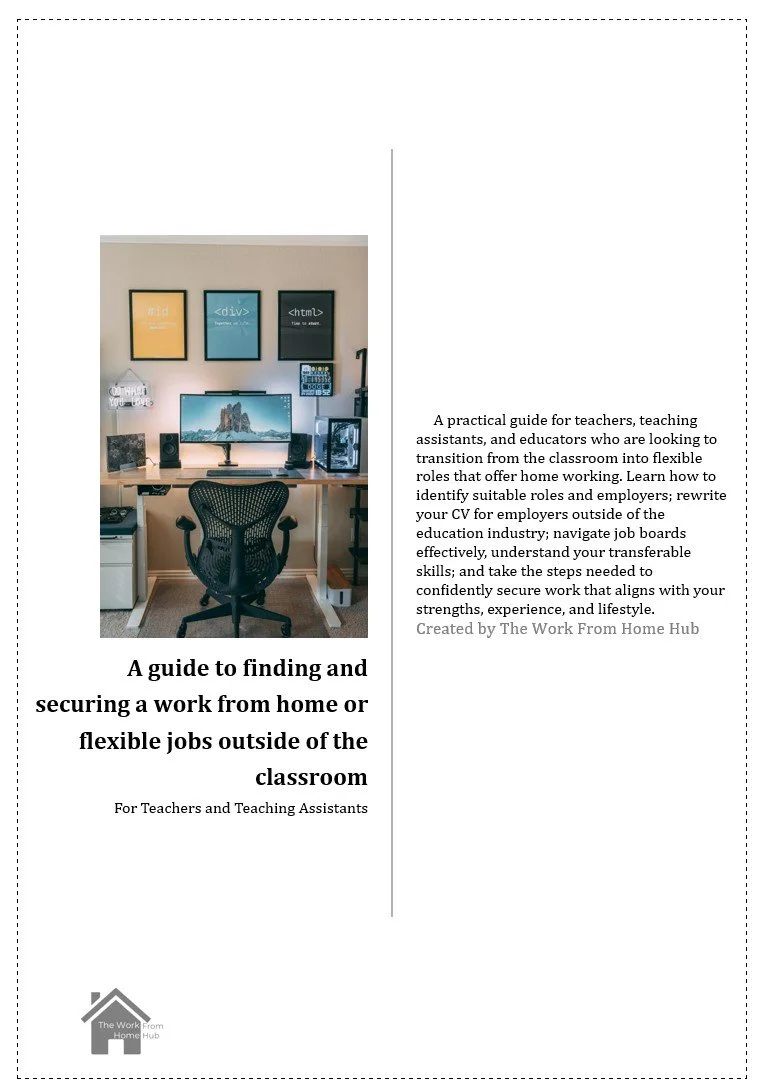
A step‑by‑step guide to finding and securing a remote or flexible job outside the classroom. Learn where to look, how to position yourself, how to identify your transferable skills, and how to navigate a new job market. Includes an editable CV template and cover letter example to support your transition.
Created by The Work From Home Hub.
This page may contain adverts for products and services tailored to those seeking homebased roles or already working remotely. These adverts help The Work From Home Hub source and share more job opportunities to our community. Support our mission - become a partner today.